Montessori Then and Now

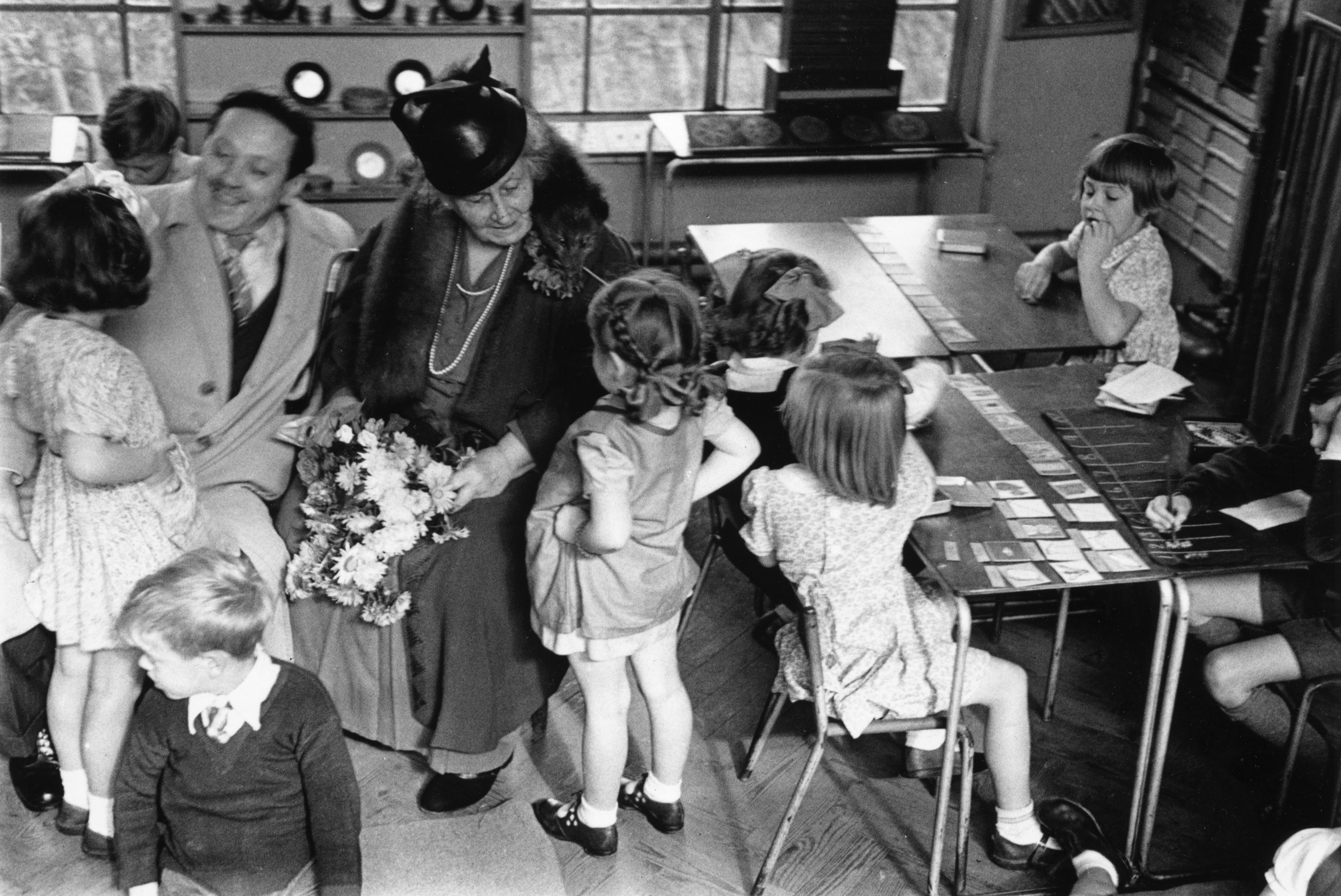
I was recently thinking about a story from the work of Marie Montessori. I think an interesting irony of the work of Montessori in terms of who she saw her mission as serving and who the schools in her name mostly serve today (at least in the U.S.). She did her work first with children with learning disabilities, getting better results in teaching reading to them than the children not so labeled were getting in regular schools. Next she went on to work with the poorest of the young children in the housing projects of Italy of her time. She was a pioneer of showing how students need to be actively involved in their learning using all their senses (particularly through movement and touching things, what we would now call kinesthetic learning). She also saw her job as working with the families, not just the children individually.

Maria Montessori

But, in this country anyway, schools using her methods have been made available almost exclusively to the privileged in independent private school setting. I wonder what she would have made of this evolution of her work.

“Our aim is not only to make the child understand, and still less to force him to memorize, but so to touch his imagination as to enthuse him to his innermost core.” ~ Maria Montessori

Reading…Naturally

I was recently covering a Language and Literacy class for a colleague of mine. The students were teacher credential candidates. For part of the session the students divided into “centers.” In one of the centers one student was presenting to the others about “Concepts of Print.” In her talk, I overheard her say how reading “is not natural.” Her statement struck me. What I gathered she meant by it is that many aspects of reading are arbitrary, and therefore should be taught explicitly, e.g., that we read form right to left, which side is the front and which side is that back of a book.

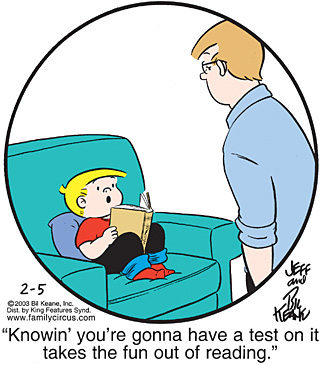
FC Reading

I do not know where she came up with the phrase of reading “not being natural,” and did not get an opportunity to ask her about it. However, I think it plays into a larger debate about reading. To what extent is learning to read more or less natural than learning other things? Does it matter?

Chomsky, half a century ago, developed a hypothesis that language learning was hard-wired into the human brain. He used this hypothesis to debunk behaviorist theories of language learning, and proposed that humans are born with a universal grammar.

While it is clear that humans have a certain portion of the brain that ends up being allocated to language, the rest of his hypothesis is speculation. As behavioral psychology has demonstrated, it is easier to train an animal to do those things for which it is predisposed toward. For instance, since birds peck instinctively, getting them to peck in a certain way or at certain things is a lot easier than to use their wing to point.

Humans seem to be born with a predilection to learn language. While someone who does not have contact with other humans will not develop language, it does appear that if in any sort of social environment, language will emerge. No one without some sort of brain abnormality or injury needs to be explicitly taught language—being exposed to others who use language seems to be all that is necessary. So, in that sense language could be seen as more natural to learn than many other things that some people learn and others do not.

Is literacy another form of language learning and therefore just as natural? Or is more like other things we learn?

Current trends in teaching literacy tend to take the view that it is not natural—some are explicit about that rationale, for others it is just implicit. One could argue that most of formal schooling is based on the notion that learning is an unnatural act, and only takes place through coercion (rewards and punishments) as a motivator, and direct explicit instruction as a methodology. The main reason students are given to do well in school is grades, diplomas and the reward of better job prospects. Information is directly imparted to students through lectures and readings. How to carry out mathematics is explained in the form of algorithms.

If you have read my earlier blogs you can probably guess my belief is more along the lines that effective learning happens naturally. But when I look at the basic principals of how language is learned—the conditions and stages of it—and compare it to other non-formal learning, I do not see any fundamental differences. In other word, I do not see a big difference in how and why we learn language as being all that different from how we learn most meaningful things in life.

My point here, therefore, is that the most effective way to teach literacy is to create an environment that most is like those in which we learn other things naturally. An important aspect of that is a form of immersion. We need to be, at least for significant portions of time, in a community where there is a lot of print, and people using that print for a variety of purposes, both reading and writing. If you look at homes where parents read and write regularly, you will find even toddlers imitating those behaviors. I think you will find that the “concepts of print” mentioned above are for the most part learned without explicit direct instruction or explicit teaching.

Another aspect is that it is risk free. No one gives us grades or benchmarks as we learn to speak, telling us we are ahead or behind our peers. When we get graded and judged, unless we are really good at something, this interferes with our performance, adding anxiety and a sense that maybe we are not good enough. When we judge ourselves as doing more poorly, we are likely to want to avoid doing that activity, and develop a sense that it is something we are bad at.

Yet at school children are constantly being judged and compared to their peers and benchmarks of expectations. Almost nothing a student does at school does not have some judgment attached to it. If not given an actual grade, students are told good job, or given a star or check mark that is was done correctly (or not). And the feedback is mostly about the level of skill, not about the meaningfulness, beauty or effectiveness in any real world sense. As Deborah Meier put it recently in a TV interview, if we taught children to speak that way, we would likely have a nation of stutterers and mutes.

We learn best when the activity we are engaged in has an authentic purpose. In school we seem to teach reading and writing as if the only purpose was so that we can pass tests of reading and writing—or for some future need. In the rest of life we learn most things, language included, because they have a specific purpose at the time we are learning to do them.

When we create schooling that uses the normal outside of school factors of learning – immersion in authentic activities with mentors and peers in a non-judgmental climate — we see a lot more success.

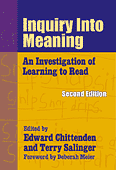
Inquiry into Meaning

Inquiry into Meaning

Chittendon-IiM

by Edward Chittenden, Terry Salinger, and Anne Bussis
Teachers College Press.
2001

For those interested in how children learn to read, I really think this is one of the very best books out there. It is actually a study of how children learn to read, rather than a study of how people teach reading or a book describing a theory of learning to read.

Academic studies that claim they are about learning to read are almost exclusively studies of a particular approach to teaching and how well students did on tests of reading after being exposed to that approach (the National Reading Panel report, which I have critiqued in an earlier post, for instance, was based solely on such studies).

This book took a different approach. A group of researchers sponsored from, of all places, the Educational Testing Service, decided to do an in-depth qualitative and somewhat longitudinal study of the children, rather than the teaching. This was a close examination of what the children were doing as they were learning to read, how they approached text. This was done much in the spirit of how Piaget examined intellectual growth of babies—by close examination of individuals. It takes a deductive, grounded theory, approach. Rather than testing some theory, it attempts to build a theory out of the data.

As the preface puts it: “This project entailed classroom documentation of over 80 children going about the challenge of making sense of print…over 2 years of instruction” (p.xi). The children came from several different classrooms and schools, with teachers using very different teaching methods.

The book is divided into several section. In the beginning the research process is described. Then the book looks at what they learned in different areas, from what supports learning to read, to how students use those supports and knowledge. The next part, which seems to be the main conclusion of the book, is a look at learning styles and its relevance to learning to read. It seems the teaching approach had little if any direct connection with the approach the students actually took to learning to read.  Lastly are case studies of three representative children.

The book is fascinating and full of rich description of the children and how they attempt to make sense of print, books and the world.

I think it should be required reading for anyone who teaches reading, and recommend it to anyone who is just fascinated by the topic.

P.S. Here are some other good reads on the topic of how children learn to read.:

  • Frank Smith, Understanding Reading: A Psycholinguistic Analysis of Reading and Learning to Read. 6th ed. (Lawrence Erlbaum Associates, 2004).
  • Stephen D. Krashen, Three Arguments against Whole Language & Why They Are Wrong (Heinemann, 1999)
  • Gerald Coles, Misreading Reading: The Bad Science That Hurts Children (Heinemann, 2000)
  • Kenneth S. Goodman, In Defense Of Good Teaching: What Teachers Need to Know about the “Reading Wars” (York, Me: Stenhouse Publishers, 1998)
  • Jeff McQuillan, Literacy Crisis: False Claims, Real Solutions (Heinemann, 1998)

Learning Modalities

It is common knowledge in education that knowing one’s, or one’s students’, preferred learning modality is important or at least helpful in designing learning strategies for ourselves or them. When I do a search of learning modalities I find dozens of articles in educational journals about how to use this information and why it is important. The interesting thing is that the empirical evidence does not support the claim, despite its popularity. And this lack of support is not for lack of investigation.

modalities

First, I want to be clear on what learning modalities are and are not. They are basically the receptive modes of taking in the world—most commonly aural (hearing,), visual (seeing), and kinesthetic (feeling, touching). These are not to be confused with learning styles (of which there are many versions such as field dependent or independent, liking to work alone or with others, risk-avoidant or risk-taker, introverted, extroverted). Nor is it to be confused with Gardner’s seven or eight Intelligences, which are ways of understanding, and really describe thinking about the world rather than how we receive information, which is what modalities are about.

We believe in our modality preference for the same reason humans believe many things that are not true. It just seems so intuitively true. We all have a sense of how we best take in information. Also, it is so often repeated – and even accepted and promoted by supposed experts – that it must be true. There are lots of tests designed by psychologists to measure our modality prefernces and help you figure out your strength. When I first took psychology in the 1980s this dichotomy between the common sense belief and the evidence was pointed out by one of my professors. Even then it had been studied and found to be false. In the 30+ years since then, the literature has continued to pour out on how to teach to modalities, and the evidence that such teaching does not actually enhance learning has also continued, and continued to be ignored by the practitioner side of the field. Special education teachers might say, “Well maybe it is true for regular education, but in special education these differences are real.” However, most of the research is with special education (as are most of the advise articles), and it is just as false in special education as in regular education.

It is a fact that in humans it is the visual area of the brain that is really the biggest—it is just the way that humans have evolved to take in the world. This is true of everyone unless they are blind or are brain damaged in some way. As social beings, however, we interact with other humans to a large extent though hearing and speaking. It is our verbal communication with others that to a large extent fulfills our needs as social animals. Many people claim that, although sight is our most central perception, being deaf is psychologically worse, because it isolates us to a greater extent than does blindness.

And whenever I ask about how people like to learn (not meaning modalities) virtually everyone says “Oh, I’m one of those people that needs to be actively involobved.” We are all kinesthetic, we all learn though doing, touching. And again, the humans have evolved to actually need, desire, touch. There is a famous experiment where a baby monkey will choose the artificial mother that provides soft embrace to the one that provides milk but no physical stimulation.

The fact is that the human brain is extremely interconnected, with each part constantly communicating with the other parts and it puts all the information together to make sense and act on the world. This misreading of the fact that we can divide the brain into parts that control certain functions and trying to then act is if they work independently reminds me of the other fallacy people used to talk about–being “right” or left” brained. Again, while different functions are controlled on the right and left hemisphere, unless we have had an old fashioned type lobotomy, both sides interact at every moment and our brain acts as a whole.

What I have discussed is that all of these modalities are central to being human. What the research has shown is that when you use all modalities all learners learn better! This is really a boon for teachers, since instead of feeling like you need to test each of your students for their strengths and then design separate lessons for each type learner, now what you are best off doing is designing lessons that utilize all modalities. The more modalities you use, the more all students do better. For all students relying on just one or two is exactly that—less.

I give the example of my getting directions. I could just hear it (or read it) (auditory) “Turn right here, turn left there….” Or I could look at on a map (visual). But getting both helps me remember it even better. And then what I like to do, to really get it down pat, is stand up and point the direction of each turn, in turn, maybe even turning my body as well, as I go over it (kinesthetic).

So take heart, the truth in this case makes our teaching easier, not harder.

As one researcher put it, “The contrast between the enormous popularity of the learning-styles approach within education and the lack of credible evidence for its utility is, in our opinion, striking and disturbing” (Pashler el at, 2009).

Some references:

Kampwirth, T. J., & Bates, M. (1980). Modality preference and teaching method: A review of the research. Intervention in School and Clinic, 15(5), 597-605.

Kavale, K. A., & LiFever, G. (2007). Dunn and Dunn model of learning-style preferences critique of Lovelace meta-analysis. The Journal of Educational Research, 101(2).

Pashler, H., McDaniel, M., Rohrer, D., & Bjork, R. (2008). Learning styles: Concepts and evidence. Psychological Science in the Public Interest, 9(3), 105-119.

Sanley, J. D. (1987). An examination of student learning styles and learning modalities on problem-solving success. Unpublished Dissertation, University of Nebraska – Lincoln.

Woolfolk, A. E. (2013). Educational psychology, 12th ed. Pearson.
Emotional Intelligence

I am writing this from the Fall Forum of the Coalition for Essential Schools. I just attended a workshop by Kathleen Cushman on “Learning by Heart: The Power of Social Emotional Learning.”

She stated in one of the bullet points of her slides of how building social emotional learning supports academic learning. I think there are very few people who would disagree with this, though it is true that many teachers feel unequipped for, resentful toward, or object to being expected to deal with this aspect of teaching. However, what I notice here, is that often as educators we feel the need to defend anything we do in schools not as valuable for itself, but for how it will help raise test scores, or at least help academically. I have seen this in defense of the arts, in defense of physical education, in defense of good nutrition, etc.

dumb question

As the author of Emotional Intelligence demonstrated fairly convincingly, to get ahead in most occupations takes emotional intelligence at least as much as it took academic smarts (according to the web site EQ accounts for 58% of your job performance, though I have no idea how one would quantify that). I would argue that this is at least as true in civic life. Political and social change happens when people work together for such change. Not to mention the importance of getting along with our neighbors, our families, etc.

Now, since my assumption is that the purpose of public schools is to serve the larger public—that is not just to help the individual become smarter and more marketable, but to be the place where society educates the next generation into the knowledge and values that are required to sustain and maintain itself. In the case of our country, I see that as helping create a democratic citizenry of a pluralistic society.

This leads me to challenge what we just take for granted—what is the purpose of schools. Most of use rarely think deeply about this question, and assume it is self evident—and that it is primarily “academic.”

But how about this thought experiment; What if we turned this on its head? What if we thought the primary responsibility of schools was to get a citizenry that has a strong social/emotional education? That our schools’ responsibility was to have graduates that had a strong sense of self-knowledge, that are good at managing their own emotions? Graduates that know how to be empathetic, that know how to effectively work with others, and be sensitive to others. Academics, P.E., the Arts, Nutrition, etc., might be seen as instrumental to living an emotionally and socially satisfying life and to contributing to the social and emotional health of the larger society. Just a thought.

Teacher Tenure

There was a recent lower court ruling against so-called “Teacher Tenure” here in California. I am really not sure about the extent of the ruling, but the general verdict was that “tenure” was unfair to providing an equal education for all students as called for by the State Constitution.

I believe the reading was faulty for a broad range of reasons. First of all, teachers in California do not actually have tenure, at least not in the sense that professors get tenure.

When a professor has tenure they can be fired only for some gross negligence or breaking of the law. Poor teaching, doing a shoddy job, or poor research cannot lead to loss of position under most university tenure rules. Of course, it takes much longer (typically 7 years) and a much more difficult process for professors to get that protection than for k-12 teachers to get their “tenure.”

americas-corporate-headquarters-comicAs for k-12 teachers in California, my understanding is that what we received was “Permanent Status.” In a teacher’s first two years (or more if they do not have a permanent position contract) there is no due process—we can be rehired or not for the following year completely at the will and whim of the district. No reason need be given, and typically no reason is given. After the probationary period, we receive “Permanent Status” within that district. If you move to a new district the process starts all over. But, by law, all teachers are evaluated by their principal or supervisor at least every 2 years. The law does not prevent teachers from being evaluated more frequently (though occasionally local contracts my stipulate limits). If a teacher receives an unsatisfactory rating—a rating that is up to the principal or supervisor—then that automatically means they are in danger of losing their job. They are given the opportunity to show improvement, so there is a process. However, that improvement is evaluated by the same principal or supervisor as gave the original evaluation. If ther supervisor deems they did not show imporvement, then the district can fire the teacher. “Tenure,” for k-12 teachers in California, does not in any way shape or form mean they cannot be fired for poor teaching. The fact that poor teachers are not let go is completely a lack of principals and supervisors doing their job. Often the reason they don’t is their own lack of training and support and that they are often feeling overwhelmed themselves by an impossible job. In this area some principals work in elementary schools of up to 900 students with no assistant principal due to cutbacks.

Many states do not allow teachers to have the protection of due process (e.g. “tenure”). Charter schools, for the most part, do not give teachers such protections. Yet, there is no evidence that they get better outcomes for students. Charter schools do not outperform schools serving like students here in California or anywhere else. Nor do states without tenure outperform states that have tenure. Without even a correlation, much less cause-effect relationship shown between teachers with or without  “tenure” or and student outcomes, to take away such protections claiming it is for the sake of student equity makes no sense at all.

What “tenure” protects is teachers being arbitrarily fired, or as is more often the case, fired for their views or for being outspoken. “Tenure” is a form of due process. It just says the district must show cause in order to fire someone. I lost my first teaching job, for instance, while still in the probationary period, even though I had all excellent teaching evaluations. What I did that was not so smart was openly express disagreement with some of the district policies. As I was still probationary all they had to do was say, we are not asking you back for next year. Even with the protection of due process, I have much more often seen principals and districts go after teachers for being “trouble makers” (i.e. expressing dissent as to school or district policies) than for poor teaching.

The solution to poor teachers is really four fold (at least). One is to attract better teachers. That means making the field more attractive not less. Lack of job security does not help attract people to the profession. Another is to continue to support teachers once in the field, something we do a poor job of. No teacher wants to be a bad teacher. And good teaching can be learned. Also many teachers teach under horrendous conditions. With proper support both in terms of teaching conditions and ongoing professional development, there would be very little poor teaching. We also need to support principals more in the process of both helping weak teachers, and helping them get rid of the bad ones. Lastly, and I do mean lastly, there probably does need to be a better system for figuring out what to do with those very few teachers who either are not cut out for teaching but somehow did get “tenure” or who have burned out and are no longer up to it, but cannot leave teaching because there are no other options for them economically.

The real agenda of the attack on teacher job security is really to reduce the power of teacher unions and an attack on public school teachers in general. Teacher unions are seen as a threat to the almost unrivaled power of the multibillionaires and corporate money in the American political arena. As it is they easily outspend unions 10-1, and seem to control the public discourse about most political issues are framed. Can you imagine their power once they completely decimate what little there is left of the unionized base in this country?

Early Childhood Education

I just got an email asking me to sign a petition to better fund early childhood education. I have to admit, though, that talk of early childhood education always raises mixed emotions with me. On the one hand, how could I not want to give disadvantaged youth the opportunity for quality early childhood education. And there is good research on the both how it can make a difference and on the real lack of it for many children.

But there is the rub. What is quality early childhood education? Over the past decade we have seen kindergarten turn into first grade. A place of worksheets and formal direct instruction.  A place where children quickly learn whether they are “good” or “poor” students. Where they are put in the “fast” or the “slow” group.

Yes research study after research study, as well as comparisons to other countries have shown that earlier is not better. Countries that start formal teaching of literacy later tend to actually do better at literacy over the years. Comparative studies of developmental early education versus formal instruction has shown similar results–developmental forms that do not stress formal teaching leads to better lasting results.

But when I hear of expanded early education, I see that in this country what that likely may mean is early formal instruction, early sorting kids into those who are seen as good at school and those who are not, creating a self-fulfilling prophesy, and taking away a time that should be for children to explore their world, and learn to socialize, and play.

If early childhood education means a time when kids received supported opportunities to be involved in play, in exploration of materials, exposure to wonderful stories and print, to interact with playmates in a safe and supportive environment, I am all for it.

If it means starting “first grade” at 3 or 4, then might we doing more harm then good?

So it is with such fears that I hear talk of expanded early childhood education.

If I Were in Charge Part 2

People sometimes ask me what I think needs to be done with the schools. This is really a two part question for me. One part is the policy side—what should or should or should not be required. The other part of the question is what are my ideas of what a good school and good teaching look like, which does not imply I believe in mandating those ideas even if I could. In my previous blog, I addressed the first part of the question. Now I will briefly tackle the second part.

A good test of schooling is whether one would send one’s own children there. Those who have read my other blogs entries know I favor progressive/constructivist pedagogy. That means that students have to be engaged in activities that matter to them in order to learn. The more those activities are connected authentically to the kinds of activities one engages in outside of school, the more likely what they learn can and will be used beyond school. There is both the need for students to be able follow their own personal interests and abilities, and expanding those interests.

One also needs to think bout how the experience of school shapes both what a student learns about, and what kind of climate and culture they learn it in. As psychologists such as Vygotsky, Bandura, Wenger and many others have shown, we learn more indirectly from how we experience the world, and watching how the adults in our world act and interact, than we do from any explicit instruction. Therefore, as much as possible the school should recreate the kind of culture, society we want our students to learn to be part of.

There is a built in tension in a democracy, between individual rights and pursuits, while recognizing that we are also part of a larger society. Fascist and totalitarian states focus on the state over the individual, and so schools in such a culture would teach students to obey and focus on obedience to higher authority. In an anarchist or libertarian state it would focus on the rights and liberties of the individual (would such a system even have public schooling, much less compulsory schooling?).

In my school students work not just individually, but also with others, others who are both alike and different than themselves. That in itself is one of the most important skills that I see any citizen needs. Most of what we do in life is in collaboration with others, in both the work and civic spheres. Humans are, by nature, social animals. The way a school and its curriculum is organized takes that into account. It means assessments that are part of the learning process and that mimic or are actual real life products or performances for the most part.

Long term projects would be at the center of most learning activities, activities that require students to integrate a variety of skills and abilities across disciplines. This mimics the kinds of activities and work people engage in for the most part outside of school. Real learning takes place when we work at real tasks that matter. The more in-depth the project is, the deeper the learning will be, and the more likely it will stay with us. Such learning takes time.

Students would sty with the same teacher for a minimum of two years. Deep learning takes deep relationships, and when teachers and students only work together for one year, those deep relationships are hard to build, with the family as much as with the student. If you are changing whom you work with too often, it gets hard to put in the investment in the relationship.

The school would be run collaboratively among the faculty. While it is important for all members of the school community to have a say, how much say would vary depending on the kinds of decision. Major curricular decisions would be the purview of the teaching faculty.

Another aspect is school size. Most of the above ideas are hard to implement in a large school. The larger the numbers of people the more such institutions must make decisions based on expediency and the smooth running of the institution rather on the educational needs of the students. Also, the number of people needs to be small enough so that the school can be a community where all members actually can get to know each other over time.

Some people claim such schooling is only appropriate for the gifted, or is not practical, and could not work in the real world. However, as I have documented in earlier blogs, the evidence is quite strong that it does work, and that actually such practices are probably more important for the disadvantaged than the advantaged, since the advantaged get so many of these advantages outside of school.

If I were in charge…

People sometimes ask me what I think needs to be done with the schools. This is really a two part question for me. One part is the policy side—what should or should or should not be required. The other part of the question is what are my ideas of what a good school and good teaching look like, which does not imply I believe in mandating those ideas even if I could. For this blog I will look at the former, and discuss the latter in my following blog.

miketest4What I would change is the mandating of curriculum (so called Standards). The mandating of standards for education in a democracy can only be justified in the case of an overwhelming consensus on such standards. There is no evidence for such a consensus, and lots of evidence that these is considerable controversy over both what such a curriculum should look like and whether there should be one at all. While I have my views on what I think all children should learn, I do not see it as my, or anyone else’s place to impose those beliefs on others, much less an entire nation.

Along with that is we need to get rid of high stakes mandated standardized testing. Standardized tests have so many problems, not the least of which is that they impose a standardized curriculum. If a certain test is required , and there are high stakes for how one does on that test, then teachers must teach to it, and students must gear themselves to it as well. That means standardized curriculum. Standardized tests are also, by definition, culturally biased—they have to be normed, which means an automatic bias to the dominant group. That is just a fact of psychometrics. And, as the test makers have admitted, their reliability for individuals is not all that great, and yet they are used to judge individual students. I also do not accept their validity for much more than a test taking skills, schools skills, and one’s zip code.

What I do support is a strong public school system. One thing such a system needs is at the very least equalized funding, and really more funding is need for those who live in poverty and have other strikes against them in life to at least begin to equalize some of the built in advantages those that are well to do and of the dominant culture can give easily to their kids without schools.

I also would not allow schools supported with public funds to select students. The only selection that can be justified is to balance in terms of demographics to more equally represent the community. Such balances do matter. It does matter that we are raised and schooled with those that represent the larger society. Schools of choice are great if the choice is the choice of the students and the parents and not of the schools. One way charter schools often get around this is counseling students out with such phrases as “Your child would/does not fit here.” I would ask of anyone stating that, “Do you have a better school for my child than this one?” If they cannot honestly find a better fit for that child, one that all parties agree to, then they have no place making such statements.

I would give local schools and localities autonomy over what and how to teach. But they would have to publicly justify their decisions, allow for public input and make their results public. What kind of results would vary, but again, they need to justify why they think the results they have used demonstrate a well educated democratic citizen. There would need to be some sort of democratic governance, but that can look different in different places.

These are the main things I see that are justifiable at the national or state level. Others you can think of?

The second part of the question is what do I think good teaching and schooling look like, which I will explore in my next blog.

School Deform

Regarding the current moves of so called school “reform” at the national level. The aspect of this is toward a nationally standardized curriculum (i.e. Common Core). And it is standardization, not standards that are being mandated—make no mistake about it. Standards refer to the quality of something. There is little about quality in the national curriculum—rather what is mandated is the content. The only mandate about quality is about competition—that students have to score above certain cut off scores (and teachers being paid according to those scores). But scores do not equal quality—they equal quantity. These scores tell us virtually nothing about the qualities of the work that students (or teachers) can perform, certainly not about work that matters beyond testing.

FireTeachersCartoon

What mandated curriculum means is that what we want from public schools is a standardized citizenry. It really is that simple. We cannot teach innovation, creativity, and certainly not democratic citizenship in a school system where one answers to test scores on a curriculum to which those carrying out and engaging in that curriculum have virtually no say.

Those that are enacting this know that those with resources have a way out—schools for the rich still allow for creativity and self governance. That is what the privatization movement, along with the charter school movement is about (at least in part). This, as we know of everything else that is privatized, leads to a system in which the quality is based on one’s ability to pay for it. Those with the most resources can and do pay for schools that still allow for creativity, choice and abundant resources.

So really, the question is simple—if we want a system that teaches one group of children (and their teachers) to be obedient and standardized, and another group educated to be creative and powerful, then we should continue these current reforms. If we want democracy, then we need to democratize schools, and give them the resources and freedom that the rich seem to feel their own children deserve. It really is that simple. Have we or have we not given up on the idea of democracy?