Differentiated Instruction

One of the buzzwords in education these days is differentiated instruction. In the field of teaching this means that we create different lessons for our different types of students.

Differentiated instruction is the way in which a teacher anticipates and responds to a variety of student needs in the classroom. To meet student needs, teachers differentiate by modifying the content (what is being taught), the process (how it is taught) and the product (how students demonstrate their learning).”  (from http://education-portal.com/academy/lesson/what-is-differentiated-instruction—examples-definition-activities.html)

The idea of differentiation is that some of our students are different—e.g. some are second language learners, some have learning disabilities, some are just behind, some are “gifted” etc. These students need either different lessons, or more commonly alterations and adaptations of the lesson that the “regular” students get.  This is seen as an advance from the one-size-fits-all structure of many lesson plans and textbook lessons. In fact most textbooks now come with suggestions for such adaptations. All of this sounds very good—we are taking seriously that not all students are the same and helping teachers to support such students.

TeachingDisability

But is this really such a good idea? I am going to critique this theory on a few levels. One, is it realistic? Elementary school teachers already have a massive job on their hands making lessons for each different subject area. Now they have to multiply that by how ever many different types of student they have. An adaptation for their second language learners. But can they assume all their second language learners need the same adaptation? One might be a new comer, another an intermediate speaker. Then there are the students with learning disabilities. But again—each one of these is likely to have a slightly different disability. And we move on to the “gifted” students. And what if some students fall into more than one category? When and how does a teacher find time to create all these adaptations and manage them?

There is also the factor that this approach singles out some students as “normal” and others as “different” needing differentiation. There is a lot of evidence that labels often become self-fulfilling prophesies for students. It also sends a message about normalcy to both groups. How will this effect the self-identity of these students, and the view of them by other students?

So, should we return to the one-size-fits-all approach so as not to single out students and to make teachers jobs easier? This is one of those false choices. These two choices assume a teacher (or textbook) centered approach to learning.

Another option, that progressive educators have been practicing successfully for over a century is to have lessons and teaching units with activities that are open-ended and allow students to find their own approach that meet their individual interests and abilities while still helping them develop necessary skills and abilities. This actually mirrors how people have learned effectively outside of school since time immemorial where people of differing abilities, backgrounds and interests all work together on common tasks. Thematic instruction, project-based approaches often fit this. One common example of this approach is the Writer’s Workshop. All students work on writing a class book, maybe even within a certain genre or topic, but they all get to write what they want within that framework. They each can work at their own pace and ability, and the teacher and their peers all help each other refine their writing.

Larger projects can use this approach as well. Such a project might be the study of an ancient civilization. It might be the investigation of one’s community. It might be an examination of the physical environment. In this approach students investigate, build, write, read, observe, and create around the theme, each at their own level.

I am not going to say this approach is not a lot of work for the teacher, but it is not about creating lots of individual lessons, but rather creating a climate for learning, making the materials and resources available, and then knowing how to support each student to do their best within that framework.

To see a wonderful example of this approach at the elementary level see the video “We All Know Why we are Here”

Relationships

The more I think about education and learning, the more I see relationships as the key to what really matters. If I think about all the movies I have seen about “great teaching,” both fictional and those “based on a true story,” while the actually teaching going on in them varies enormously, what they all have in common is a teacher that builds caring strong relationships with their pupils, from “To Sir with Love” “Up the Down Staircase” of the 60s, to more recent movies such as “Mr. Holland’s Opus” and “Dangerous Minds.” But of course that portrayal could just be the license of the writers and directors.

teacher_kid_off_work_459715

But I would say I have found the same in my experience as a teacher. I worked with teachers with many different pedagogical approaches. If you have read my previous columns, you will see it is clear I have strong beliefs abut which are more effective. However, the most consistent thing that I noticed of teachers that appeared to me as more effective was that those teachers all had strong relationships with their students. The students knew their teacher expected them to learn, and was there to help them succeed in doing so.

It was really much for this reason that I decided to become an elementary rather than high school teacher. I did not see it as possible to really build those relationships if every hour I had a new group of students. With elementary school kids I had the same ones all day long. (It is also a reason I have never liked “regrouping” with other teachers—I never saw the trade off as worth the loss in knowing my students fully).

One anecdote. At one place I taught, we were using the Reading Recovery program for our struggling first grade readers. Reading Recovery is a strongly researched based program giving intensive support to the lowest readers in first grade, based on some of the best research of learning to read, with a strong research record of its own, and all the practitioners of it have to be credentialed teachers who have gone through an intensive training in the model. However, as a second grade teacher, my struggling readers did not qualify. So instead we used instructional assistants, who had a rudimentary training in more traditional phonics approaches to work with them. I would argue that second graders who are still struggling with reading are probably actually more difficult candidates, as they have a longer history of failure to overcome.

Yet, in the decidedly non-random and small sample that this consisted of, my instructional assistant succeeded with every one she worked with to at least getting them to the point of breaking the code in learning to read. The same cannot be said of the Reading Recovery program that had about a two-thirds success rate with our students. I attribute it to the strong relationship she built with each of them—letting them know that she believed they each would and could learn to read.

This, maybe, is what worries me most about many of today’s’ educational reforms. They make those relationships more difficult. Scripted curriculum, larger classes and school consolidation. use of technology for instruction, and worst of all, the tactics of fear—trying to scare teachers and students into doing a better job. Each of these, in a different way, makes it slightly more difficult for teacher and students to develop strong relationships.

I am about to embark on teaching an all on-line teacher education course. I will see to what degree this mode allows for and interferes with such relationships.

Poverty and Education

Progressive educator Deborah Meier and Michael Petrilli of the Fordham Foundation have been debating on EdWeeks’s Bridging Differences blog.

In his most recent post Michael claims that poverty is not the issue (even though, as another commentator to his post mentioned, the issue was not originally framed as poverty, but inequality, even in his own words).

From Petrilli’s Bridging Differences blog:

  • “Most were born to single mothers, and their fathers have been absent from the start, or by the time they turn two or three;
  • Most of their mothers were teenagers or in their early 20s when they gave birth;
  • Most of their mothers have very little education—a high school diploma or less–and thus few marketable skills;
  • Many of their mothers suffer from mental illness or addiction or both;

“If we give these families more money…will it erase the huge gaps….between these kids and their age-mates born into two-parent families? With highly-educated mothers and fathers? To believe so, you’d have to put as much faith in cash transfers and social services as some reformers put in schools. You’d have to believe in miracles.”

income gapIn response, I would say that tackling poverty and creating full employment and tackling society’s inequalities would actually help solve those too. Fathers are absent because they cannot support their families. Young motherhood is often a symptom of hopelessness, as is drug addiction. Michael shows data that America’s poverty is not really that much worse than other countries (though still worse even by his figures), so the problem cannot really be poverty (since he also accepts the data purporting that they do better academically). What he leaves out is that even if its true, those other countries do a better job of providing the supports for the poor that he derides as useless–housing, medical care, food, pre- and post- natal care—than the U.S. It may be those supports that keep fathers at home, create less single motherhood, and provide the supports needed for those who are single mothers.

While most critics of our current economic system and I think giving the poor more money and supports is a good idea, we do not see it as the solution either, but rather a band-aid, and when you are bleeding a band-aid is good to have! What is needed is a society that can provide meaningful employment for its citizens, that can provide decent housing, food, medical care, etc. It needs a society organized for a more equitable distribution of the resources.

A better education for the poor helps the individual student succeed, but it does not create more jobs nor reduce the overall rate of poverty nor solve the issues of inequality in a developed country such as ours. It does not change the number of winners and losers, though it just might even the odds a bit as to who gets to be winners and losers.

As John Dewey noted almost a century ago, a certain type of better education, i.e. one that help students participate and understand democracy and develop certain habits of mind, can be one of the aspects to creating that society, but it alone cannot do the job. And most of the reforms that Petrilli supports—more testing and top-down “accountability” based on that testing—actually create a less, not more democratic culture in schools, especially schools for the poor.

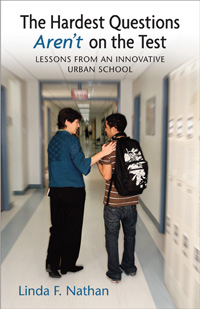
The Hardest Questions Aren’t on the Test

This is a wonderful book about the Boston Arts Academy written by the principal. In the genre of Deborah Meier’s The Power of their Ideas, discussing the history of the school to illustrate what it takes to make a powerful school. She describes the ups and downs. She gives stories of particular students. She describes how the school has developed, going through changes and struggles. She uses these stories to help us understand what schools could and can be like, how they can be powerful places for all to learn.

hqat

The Hardest Questions Aren’t on the Test:
Lessons form and Innovative Urban School
by Linda Nathan
Beacon Press
189pp

Schools and the Business Model

Policy makers and the current so-called reformers talk about the need to run our public educational system more like a business. From what I see, that is being done, with the same disastrous results.

We see businesses paying their CEOs exorbitant salaries while reducing their labor forces and cutting the wages of those who actually do the work. Often these CEOs are hired irrespective of their knowledge or experience in the field or of whatever product or service that company is engaged in. Then when their policies fail, they are paid huge sums to buy out their contracts, while a replacement CEO is paid even more.

In education we see the same rise in wages for superintendents, especially of large school districts, while cuts are being made everywhere else. Often these new leaders come with no educational backgrond at all, their only experience being in the business world. And when they fail, they too see their contracts paid off while a new superintendent is hired at a higher salary.

In business more attention is being paid to short term profits to give investors a quick return on their money, often at the cost of long-term quality or stability.

In education we see schools forced to find ways to get short term test score gains per Federal and State mandates, which are often made at the cost of building a solid educational foundation and understanding.

In business companies engage in cooking the books to make their profits look better than they might actually be, and we read about these scandals almost daily. In education we see districts and schools cooking the books and engaging in practices to make their test scores and other data look better and we act just as surprised as the same scandals appear in education.

In business quick profits are the goal, at whatever cost, legal or illegal. In public schools better test scores are the legal tender to be attained at whatever cost.

Schools are learning to act more like contemporary businesses. In business such practices have taken the world’s economies to the brink of disaster and brought us the worst recession since the Great Depression, while the gap between rich and poor continues to widen. Such practices and mindset are doing the same to our public educational system, widening the gap between the quality of education for rich and poor.

One might notice that it is practically unheard of for the private schools where the elite send their children to use the rhetoric of business practices to describe their own schools.

Standards-Based Education

Currently in education there is a lot of talk about standards-based education and the need for high standards. I will discuss in this column where that concept came from and how it has been distorted from its original use.

The idea of a standards-based educational system came from the work of Ted Sizer (1932–2009). In the early 1980s he was involved in a nationwide study of high schools that resulted in his book Horace’s Compromise (and later Horace’s School and Horace’s Hope). In Horace’s Compromise, Sizer describes the work of a typical teacher, and how no matter how willing, well-meaning, and hardworking, the teacher cannot meet the needs of the over hundred students he sees everyday, and how students by the same token cannot do deep quality work while jumping from one subject to another each with a different teacher and mostly sitting there being expected to soak up facts and concepts. In other words, the lack of real quality learning going on in schools was not the fault of teachers or students, but the design of the institution and the compromises teachers and students made with each other to survive in such an institution.

Sizer proposed that instead of students being rewarded for successfully passing a certain number of courses, and being in school a certain amount of time, they be required to demonstrate the knowledge and abilities of a successful high school student through some sort of performance assessment where students actually showed they could apply what they had learned. He also posited certain attributes that schools would need in order to carry out such an education. What came out of that directly from Sizer and likeminded educators was an organization, the Coalition of Essential Schools, which holds a set of ten common principles that schools doing such work adhere to. This organization supports schools in trying to make the changes to move toward applying these ideas. According to Sizer, how schools would measure this success, and how each school would carry out those principles in practice, needed to be locally decided.

This idea of Sizer’s that students should graduate by being measured against a set of standards rather than just seat time became popularized in the 1990s. However, in many ways the concept got turned on its head. For one thing, the term “standards” took on a new meaning from its usual everyday meaning of a level of quality. Instead “standards” became laundry lists of facts and concepts, both broad and discrete, to be learned, as well as levels of performance. These standards, rather than being locally decided as Sizer proposed, have been mandated by State authorities (and now we are moving to National mandates). In most states these laundry lists of standards are typically so long that one expert declared that it would take over 20 years if students were just exposed to the material for each standard, and much more if they were really expected to master them.

The other distortion is that meeting these standards is measured by standardized tests. Performance has come to mean not what Sizer had in mind—the ability to carry out real world tasks that used the knowledge and abilities that schools decided were important—but how one “performs” on a standardized test. These standardized tests are designed to test students’ recall of a random sample of what is on that laundry list of facts and concepts. High standards have come to mean high scores on such tests.

Sizer’s idea was that graduation by standards should free up schools to look and act differently, and free up students to demonstrate their knowledge in a variety of ways. The current practice of “standards” has meant the standardization of curriculum, pedagogy, and assessment of the students, as well as their teachers, schools, districts and states by the use of standardized tests.

So far there is no evidence that the current use of standardized curriculum and the high stakes use of standardized tests has improved the quality of education. The achievement gaps these so called reforms were to solve are as great or greater than before these changes. Graduation rates are overall no better, and we do not hear high school teachers claiming that students are coming in more prepared than they used to be. So far the only response the education establishment has offered to this lack of results is that we need more standardization, more tests, and higher stakes.

On the other hand, Sizer’s ideas of standards without standardization have also been tried out, at times with astounding success. One of the first schools to implement Sizer’s ideas was Central Park East Secondary School (CPESS) a public school of choice in New York’s East Harlem. Deborah Meier, building on her work at Central Park East Elementary School, collaborated with Ted Sizer on how to meld his ideas and hers to develop a secondary school on the Coalition principles. They came up with a school where students studied fewer topics, and worked with fewer teachers more intensively. All faculty and administrators worked as advisors who stayed with students over time and met with their advisory group daily. Students took part in internships in real world professional settings. The standards of the school were upheld through a series of portfolios and defenses of those portfolios in front of a committee. Students graduated, not after a prescribed number of years or prescribed number of completed courses, but when they had successfully passed and defended those portfolios. The standards of Central Park East were built around certain “Habits of Mind” that the faculty believed were important in all facets of life and in all disciplines. To a large extent, the demonstration of the use of those habits was the rubric used to decide if the portfolio or defense of the work met the schools standards. The students of CPESS had success at graduating high school and going on to, as well as succeeding in, college far beyond their demographic equivalents in other public high schools in New York (see David Bensman’s fascinating book Central Park East and its Graduates which documents his study of CPESS alumni).

After CPESS, a whole network of such schools sprung up all over New York City, and to some extent nationwide. Schools such as Urban Academy, the International High Schools, the Met schools, High Tech High, and Boston Arts Academy, to name just a few, continue in this tradition of high standards without standardization, of depth of knowledge over coverage, and of the importance of relationships with students as essential to successful education. While each of these school looks very different, in each school one will see students who are passionately following their own interests while being held to a common set of high standards in a non-standardized curriculum. These schools have shown that they help students beat the odds in terms of graduation and getting into college. Even more importantly, these schools produce graduates with positive attitudes toward learning and their ability to shape their own futures and contribute to the larger society.

Assessment in California Teacher Education

(This column is adapted from a talk I gave at the University of Kyoto in January, 2012)

Those in the field of assessment often refer to two important standards that assessments are expected to meet, reliability and validity. Reliability meaning that the same results would be obtained if the assessment were given again, or if a different person was scoring the assessment.

Validity means that the assessment actually measures, assesses, what it claims to be measuring/assessing—and whether it predicts how one will perform in the future (Ormrod, 2005).

One type of validity is “face validity”—that is, it is accepted that the assessment actually does measure what it claims to measure, without needing statistical proof that it does. The road test portion of the driving test might be an example of that: We can easily agree that if we want to know if someone knows how to drive, we can sit in a car with them and watch them drive. Now, what constitutes good enough driving to pass the test, that is where things might get more difficult to agree. Both how good is good enough, and which things matter most, e.g. how well the student parked, used turn signals, obeyed signs, and how much should each count, can be controversial.

Other tests need to have their validity demonstrated. The paper pencil portion of the driving test might be one of those. Do we have any evidence that those who do better on the written portion are actually better drivers?

However, while we accept that the road test has more face validity, we might wonder about its reliability, the possible subjective nature. The written portion is more reliable, you either filled in the correct bubble/answer, or you did not. However, on the driving portion, maybe the traffic conditions were more difficult when you took it than when your friend did, maybe one instructor is tougher grader than another. Maybe he had a fight with his spouse that morning! Despite these shortcomings, we accept the trade-offs as worth the advantages of such an authentic assessment. A built in safeguard is the opportunity for second, third, and as many opportunities as needed to retake the test.

It is easy to create paper and pencil assessments that are reliable and easy to administer. However, how one’s score correlates to real life application of the knowledge or skill that the assessment is designed to measure is harder to determine. Some, such as myself, argue that there is a built in tension between reliability and authenticity. Real life tasks and situation are by their nature not standardizable: Conditions vary, there is ambiguity, and there is more than one right way to approach a situation or problem. Creativity, a very important human trait, cannot be measured, and one’s ability to act effectively in novel situations is also by its nature not standardizable. Therefore to assess one’s ability to use one’s knowledge and skills in real life situation is likely to have a degree of unreliability, unpredictably.

Furthermore, what one person views as good enough, as quality, in most real life applications also varies. A movie I thought was well acted and crafted, my best friend thought was poorly acted and rang false. And that is in movies made by highly paid seasoned professionals! Multiple publishers initially turned down a number of best selling classics in literature.

Compulsory public schooling in the United States was instituted at a particular point in history, with other changes and advances happening. Part of that was the belief in scientific experts and the new field of psychology as a science rather than philosophy, and the invention of standardized intelligence tests. Americans often want to find the one right way (Smith, 1988). Americans are known for their obsession with measuring everything, and putting numbers to everything. This has played into schools in the forms of tests that can be reduced to numerical scores, and a belief that if everyone takes the same test at the same time in the same way, and test is designed by outside experts, it is therefore objective.

Critics of the standardized tests of today point out the shortcomings of such tests: they don’t really have reliability at the individual level, they are culturally biased, and their inauthenticity—their lack of actual validity in terms of measuring any important, useful skill, ability or knowledge beyond the school house walls. They also object to the indirect influence of these tests in encouraging the teaching of discreet skills and rote knowledge that is quickly forgotten once the test is over (Hursh, 2005; Kohn, 2000; Meier, 2002; Ohanian, 1999).

However, it must be remembered that standardized tests were put in place in part as a seemingly fairer alternative to an aristocratic system, where social position and money was what decided who got into the best schools and got the best jobs. Standardized tests were seen as scientifically objective tests, and therefore gave an equal chance to all. One could rise by one’s merit, not relying on family name or wealth (Smith, 1988).

What authentic assessment is proposing to do is to let people show what they know and can do based on merit, but also more accurately than standardized tests reflect the skills and abilities the person should have by seeing how they apply that knowledge in a realistic situation.

Of course even “authentic assessment” is always a matter of degree. Authentic assessments are generally applied in somewhat contrived or hypothetical situations. In school situations it is rarely practical or even possible to have students demonstrate in the real life situation, and even authentic assessments give us just a sample of the full skill being assessed. To go back to the driving test example, even on the road test, not nearly every possible driving situation is encountered. The driver is asked to carry out a predetermined set of maneuvers at the direction of the tester over a relatively short period.

A large issue for authentic assessment is to overcome the issues of “bias,” which is really an issue of reliability—would a different scorer give that person the same score? One way to address this is through multiple assessors. For instance, at some high schools that use portfolio or exhibitions for graduation, such as was developed at Central Park East Secondary School, they use multiple assessors, while also having outside experts examine their system, and watch it in practice to help them improve and refine it (Gold, 1993; Meier, 1995; Meier 2002).

Another common system to obtain more reliability that is used in authentic or performance based assessment systems is to have scorers be calibrated. A set of benchmarks are set up—examples of the performance assessment carried out at different levels, and the scorers are first trained on what qualities to look for, and then they are asked to score these benchmark examples to see if they give them the expected scores. In theory, only when they can consistently give the expected scores are they considered calibrated, and therefore the scores are considered reliable.

I will now discuss efforts in California to bring a more authentic, yet standardized, assessment in a systematic way to credential teachers.

California teachers are given their credential based a variety of factors. Some have been (and still are) standardized paper and pencil tests. However, as we have discussed, there is a sense that these are not good indicators of how well they would actually teach. These tests are used as measures of minimum knowledge of basic skills. On the more authentic side these candidates are placed in classrooms to learn to teach alongside practicing teachers. In most teacher education programs in California, this is a semester long placement. In some, such as where I currently teach, we require two semesters of student teaching. However, some worry about the standards of those assessing that experience. Were they tough enough? Are they consistent? There is no standard set of measures for that experience. The same could be said of the other criteria, that they pass their college courses to become a teacher. Were the standards from one program to another, even one class to another, consistent (Chung, 2005)?

The legislature of the State of California decided to institute a performance based assessment system on top of the other criteria to both provide an authentic, yet valid and reliable way to measure whether a candidate was ready to become a teacher.

Linda Darling Hammond of Stanford University led a consortium of universities with foundation support to develop such a system, called Performance Assessment of California Teachers (PACT) (another similar system was also developed by the Education Testing System, the CalTPA). In the PACT assessment teacher candidates develop a 3-5 day lesson plan in mathematics or reading, they carry out the lessons in their placement, and videotape those lessons. They document all of this, providing a detailed description of the context where they taught the lesson, describing the school, the classroom and what they know about the students. They provide the lesson plans, and some discussion about those lesson plans. They reflect on what happened when they gave the lessons, what changes they made along the way, and what changes they might make if they were to give these lessons again. They select a 20-minute portion of the video for the portfolio, and discuss what is in that portion. They also provide examples of the assessment used in the lesson from three students of varying abilities. They discuss what they saw overall in reviewing the student assessment, and what they learned about the three students in particular.

This portfolio is then read and scored on a set of 12 rubrics. Several rubrics address issues of planning, several look at the execution of the lessons, several others look at the issue of assessment. The issue of how the lessons helped student access and learn “academic language” is also assessed by two of the rubrics. The people who score these assessments go through a two day scoring and calibration training, and must re-calibrate every year.

In practice, despite the training and calibration, there are still sometimes disagreements (if a student fails, it automatically gets scored by a second scorer. Randomly ten percent get two scorers to check reliability). While in the large majority of cases we probably score the candidates similarly, there are cases where we have scored them quite differently. In such a system, there is room for interpretation. If the rubric asks us if the lesson was appropriate for the students, or the teacher gave clear feedback, what one of us interprets as appropriate or clear may not be the same as another.

These are the trade-offs for a more authentic system. For everything we do, that we add, something is also lost, traded. On the positive side, in my institution it has meant that we have had dialog among the faculty about creating a more cohesive experience for the student. However, as many high stakes assessment systems can do, preparing our students for the assessment itself has taken significant university class time, time that used to be spent on content. In that way students may be losing out. Some also wonder to what extent is the ability to write well, to theorize being assessed, rather than the actual ability to teach. Though assessors are told that the writing itself is not being assessed, it is for the most part a written assessment, albeit of a performance (along with the short video clip).

It is certainly a system that is more uniform than what was in place before. From my experience with the system, it does appear that the stakes have been raised for student teachers. Are the teachers who have now gone through this system, better prepared? Are we better at keeping out unprepared teachers, while not excluding prepared ones through this system? That is a much more difficult question to answer for which there are no solid “facts.”

The problem in the United States is that people are looking for a foolproof “fair” system. The attempt is to avoid human judgment, which by its nature full of biases and well, judgment! Standardized tests, paper pencil tests, offer us the illusion of avoiding judgment, but it just moves such judgment to the creator of the test. It offers reliability often at the cost of meaningfulness.

In the United States we rely on human judgment for our criminal justice system, our courts—very important high stakes decision—and while mistakes are made, maybe even often, it is seen as better than the alternative. Authentic assessment systems at heart require the same faith. A faith that the trade-off of allowing for human judgment is better than the reductionism required to assess in a standardized form. I believe we need to bring more of such human judgment back to our educational system.

References:

Chung, R. R. (2005). The performance assessment for California teachers (PACT) and beginning teacher development: Can a performance assessment promote expert teaching practice? Stanford University. Proquest dissertations and theses, 598p.
Retrieved from http://search.Proquest.Com/docview/305434959?Accountid=10355 Unpublished Dissertation, Stanford University.

Gold, J. (Producer & Director), & Lanzoni, M. (Ed). (1993). Graduation by portfolio: Central Park East Secondary School [Videotape]. New York: Post Production, 29th Street Video Inc. http://vimeo.com/13992931

Hursh, D. (2005). The growth of high-stakes testing in the USA: Accountability, markets and the decline in educational equality. British Educational Research Journal, 31(5), 605-622.

Kohn, A. (2000). The case against standardized testing: Raising the scores, ruining the schools. Portsmouth, NH: Heinemann.

Meier, D. (1995). The power of their ideas: Lessons for America from a small school in Harlem. Boston: Beacon Press.

Meier, D. (2002). In schools we trust: Creating communities of learning in an era of testing and standardization. Boston: Beacon Press.

Ohanian, S. (1999). One size fits few: The folly of educational standards. Portsmouth, NH: Heinemann.

Ormrod, J. E. (2005). Educational psychology: Developing learners (4th ed.): Prentice Hall.

Smith, F. (1988). Joining the literacy club: Further essays into education. Portsmouth, NH: Heinemann.

Why Go to College?

I usually discuss k-12 schooling in this space. However this time, I would like to address higher education. In several of my columns here I have addressed the issue of the purpose of public schools, and I am going to bring that question to this next level. One of the purposes of k-12 schools we are now told is to prepare students for college and university work. What, therefore is the purpose of college and university work? The obvious or cliché answer is to get ahead in life. However, this assumption that the purpose of college is to get ahead in life needs further examination.

In k-12 schools we are told that students must spend more time studying academic subjects. Those involved in higher education are often referred to as Academia. But the people of the United States have contradictory attitudes toward things being academic. On the one hand we have the expression “It’s academic,” meaning it has no practical significance—maybe interesting philosophically or intellectually, but when real or practical decisions matter, irrelevant. On the other hand, in schools today, especially k-12 schools, if it is not academic it is not important. Arts, music, physical education, recess, everything that is not “academic” must  be thrown out in this time of crisis. (That such a crisis actually exists is also a matter for much debate, but the media ignores that fact as well—reminds me of how at airports for the last 10 years we are in a constantly reminded over the PA system that we are in a state of emergency. Deborah Meier points out in a recent column that such a crisis seems to have always existed in our public education system.)

It was not long ago that Colleges and Universities were purposely seen as “only academic.” They made no claim to study anything practical, to prepare anyone for the workforce. To do so was seen as beneath them—that was the job of trade schools. Colleges and Universities were where the elite went to improve their minds, to become cultured and well educated—but not trained for the work world. Back when medical schools were being established as the main way for doctors to be certified, many universities resisted having medical schools attached them precisely for that reason—not wanting to be seen as trade schools.

In many fields, the more practical the study, the less esteemed it is—this is certainly true in the mathematics and hard sciences. And even within the hierarchy of university departments, it has historically been that the more practical the less esteemed, with teacher education being at the bottom of the totem pole, and theoretical sciences at pretty much the top.

However, college is more and more being sold to the public as an economic necessity. We are bombarded with charts of the higher earnings that college graduates make. We are told there is no future for those without a college degree. High schools are measured by how many graduates get in to college. Colleges advertise how well they do at getting their graduates good jobs.

For most of the first half of the 20th century most students did not finish high school. But there was no shame in that. Not only no shame, finishing high school was not seen as necessary or even useful in getting a good working class job—one on which someone could end up supporting a family and buying a home, living the American dream.

By the second half of the 1900s, a high school diploma appeared to be necessary. Now in the 21st Century, it seems the college diploma has become the new high school diploma. Whether jobs actually require the higher skills and knowledge obtained in college, or whether it is just that one needs a higher diploma to beat out the competition (or a combination of the two) is a matter of debate. Few employers actually claim that what their employees learned in school in terms of any content was really that helpful for what they needed to do the job.

Despite the debate of the actual practical knowledge learned, colleges and universities are certainly sold as the keys to an improved financial future. This has led to a crisis in identity for higher education. Many, in if not most college professors still think of themselves as teaching students in order to broaden their minds, get them intellectually interested in topics for their own sakes, improve their ability to communicate and think about the larger issues of life.

More and more though, professors are being asked, not just by students, but by administrators and the university system as a whole, to justify the purpose of what they are teaching in practical terms. Departments that are seen as practical, as leading directly to a job, are growing, such as business and engineering schools, while ones that are seen as purely “academic” shrink. And universities, in the competition for students and for money, steer toward those that are attractive in that way.

When college was just for the elite, to better their minds, professors could just say to students, if you are not interested, you do not need to be here. Now professors need to sell their students, and the university as a whole, on the purpose and practicality of what they are teaching. Students complain about having to take courses to fulfill breadth requirements, and professors dread having these students in their courses.

If colleges and universities are just places to further train our youth for a workforce that (supposedly) requires higher levels of education in our technological information rich society, why have such requirements at all? Why not just let students take those practical courses they need for the field they have chosen to pursue? Is there a place in society for the idea that an educated populace is well rounded in terms of the arts, humanities, literature, languages, and sciences? Does such a notion fit with what we want our society to look like?

Maybe we need to actually go back to differentiating between the two? Maybe to most people we offer college as a trade school, clearly focused on preparing them for a professional or economic field. Then reserve, for those who want it, an education to broaden their minds? Is there a way to separate the two without the latter being purely elitist; can we make it affordable and realistically open to all who were interested? Or is this broader purpose something we really want to insist (or encourage at least) for most people, rather than just leaving it up to see who might want it?

I believe that these are issues that our k-16 educational system is ignoring. If not addressed explicitly, the tensions will not go away, but the conflict will be resolved without a serious consideration of the trade-offs we are making, but rather will be the result of small moves seemingly made to meet the current “demands” of “the system.”

Taking the Public Out of Public Education

I recently went to a talk by my old professor and mentor, Art Pearl. Art has been a political activist, writer and teacher, focusing on issues of democratic education for over four decades. Now in his 80s, he is still teaching, writing and acting on his beliefs. He spoke about the attack on public schools, on unions, and the need for democratic education. In this column, I am going to use his talk as a springboard for expanding my own ideas on the current attack on public education and the unions representing public school teachers.

One can trace the beginning of this movement to the report, A Nation at Risk, written in 1983 written by the National Commission on Excellence in Education, at the behest of then Secretary of Education Bell. The report was really a call to arms to reframe the debate about education. It made a rhetorical claim that the mediocrity of our educational system put our nation at risk—equating it with an attack by a foreign country. No evidence was provided to support this claim. In fact, while every decade throughout the history of public education, headlines have proclaimed that it is going to hell in a hand basket, and bemoaning the loss of the good old days, most evidence we have only points to continual progress, at least up through the 1990s (see The Way We Were? by Richard Rothstein, and The Manufactured Crisis by David C. Berliner and Bruce Biddle for extensive discussion and data on this topic).

School_ChoiceOne aspect of this effort to undermine public education has been to reframe the purpose of education as purely preparation for the workforce. In the past, public schools have been considered to have multiple purposes—socialization in its many forms, citizenship in its many forms, and providing students with a well rounded general education—cultural and “academic,” meeting both individual potential aims as well as societal aims. Since that report, the public media discussion of education, including the U.S. Department of Education, has cast the purpose of education purely in terms of its economic impact. They, as did the report, describe the threat of a failing educational system as a threat to our national economy. They sell education for its ability to get one a better job, a better income—using educational attainment to income correlation data. Today, one virtually never hears mention of any other purpose for schools in the mainstream media or from government spokespeople.

Even if we accepted that schools should be about job training, the economic argument used by the government and media is mostly based on lies and false information. The claim of A Nation at Risk, (one that has constantly been repeated since) is that our mediocre schools are leading to our economic downfall. However, there is no causal link in developed countries between schooling and the health of the economy (such a cause-effect link does exist in developing countries that do not already have a basically educated population). If there were such a link, why didn’t we hear those same forces cheering what a great job our schools must have been doing when we had an economic boom in the 1990s? In fact, that would have been the work force that was in our public schools during the time to which A Nation at Risk referred. If this cause-effect relationship were correct, then our schools could not have been as bad as they claimed.

In fact, the relationship between schooling and the economy in developed countries is mostly non-existent, or the reverse of that claimed. To some extent, schools do respond to the job market. For example, in the early 1990s almost nobody studied computer technology in school. The early dot-commers were often self-educated in terms of technology. However, soon colleges and universities were establishing new programs in the computer sciences, quickly filling up with students. Then when the tech bust hit a decade later, the job market was flooded with these new graduates and the recently laid off workers.

However, for the most part, having an educated workforce neither creates nor destroys jobs. We now live in a global economy where such things have more to do with larger economic forces. Job loss in the U.S. has mostly been due to outsourcing, first of manufacturing jobs, and lately other technical and professional jobs as well. The driving competitive force is that people in certain countries will work for less, often much, much less. The way we can compete with them in a free market economy is to take lower wages, less benefits, and accept other reductions in workplace quality and safety, as well as lowering environmental protections. Having better educated people to compete for these jobs will not bring them back to the U.S.

The only area of the job market that is increasing (at least in numbers that are significant in terms of the size of the U.S. workforce) is in the service sector, jobs that actually require little in the way of schooling, and certainly not a college education. However, employers of such workers do want workers who are obedient, punctual and docile—just the sort of education that children in schools serving poor and minority children are receiving, even if they do get low test scores (WalMart, for instance, is one of the largest employers in the U.S.).

While getting a “good” education may make you, as an individual, in a better position to compete for what jobs do exist, there is no evidence that a better-educated population would in any way lead to job creation. If however, schools are just job training sites, then while it is clear that I want my child to get the best education possible, it is less clear why the “public” should care or even want good schools for all. This may be especially true if all children getting a good education means they might out-compete my child for those scarce good jobs! This promotion of schools as the pathway to better jobs makes the free market and student as consumer mentality for schooling more appealing. I need only concern myself with finding the best school for my child at a price I can afford.

However, thinkers as different as John Dewey and Horace Mann from the early days of public education, to more recent thinkers as disparate as Deborah Meier, Ted Sizer, Diane Ravitch and E.D. Hirsch, have all argued that what and how children are taught at school matters for the survival of a democratic society, not just solely for how well trained for the workforce the students will be. Schools are the place where children move from the private sphere of the family to the public sphere of the larger society. It is the habits and knowledge formed and developed in these public institutions that in part frame students’ understanding of their larger place in society. When public schooling is about preparing students to be citizens for a democratic society, then clearly we all have a stake in what it means to be an educated citizen, in what habits and understandings are promoted there, in what knowledge is imparted there.

Another connected strand to this attack on public education is an attack on unions. We have lost a large segment of our skilled workforce to other countries, and we have had several Federal administrations unfriendly to organized labor. Due to these forces, the U.S. (once the leader in organized labor) now has among the lowest percentage of unionized workers compared to any other democratic industrialized nation. However, the one place where organized labor is still strong is in the public sector. The attack on public school is part of an attack of that last bastion of organized labor, the last place where workers can speak in a unified manner as a counterpoint to the powerful voices of corporate interests.

More and more, teachers and their unions are being blamed for the supposed failure of our public school system. It is brought out in a way that connects to the general public’s emotions and immediate experience. There is a lot of current fanfare in the media that incompetent teachers are hard to fire and teachers unions block reforms (both claims central to the premise of the movie “Waiting for Superman” for instance) Do they provide evidence? Very little. An easy way to check the validity of their claim would be to compare non-union states to union states, as many states do not allow teachers to unionize. There is either no correlation or a positive correlation between states that have unions and academic success as measured by high school completion and test scores. In addition, most of the reforms that are touted as successful by the administration and think-tanks have taken place in cities with strong teachers unions.

While it may be true that it is not easy to fire poor teachers, no evidence is provided that too many poor teachers really is a major problem. Moreover, the principals I talk to all tell me that, while not being easy, they have always been able to get rid of the poor teachers they had. Is my sample of principals unrepresentative? Maybe—but then one could say that the problem is poor principals (though I hold them no more to blame than the teachers). When you make it easier to fire bad teachers, you also make it easier to fire the good ones as well. What “tenure” provides is not a guarantee of a job for life, but that the teacher cannot be fired without cause, and it puts the burden of proof for that cause on the employer. The question framed that way becomes, do we believe in due process? It is just such due process that teachers unions and the “tenure” process protect.

Charter schools and vouchers are currently the “reforms” of choice. Charter, private and parochial schools typically do not have teacher unions. These schools also bypass publicly elected school boards that oversee their vision, mission and curriculum. They often also exclude unionized or public employees for many other positions in schools—such as custodial and food services. The normal checks and balances of the democratic process are bypassed in the name of “efficiency” and the advantages of “market forces.” These forces see charter chains, and private forms of education, which answer to their own private boards, as competing for the students. Parents and children are merely consumers of this commodity, and the more effective and efficient schools will get a bigger market share. The only thing left that will be public is that it is the public’s money being used to pay for them.

This attack on the public nature of schools is in line with other current agendas of the free marketers—such as the privatization of Social Security and undermining public health care reforms. These are all part of a clear and premeditated mission to have this country run only by the dictates of the “free-market” economy (read as: run by trans-national corporations and financiers). Schooling is just one of these fronts.

The only thing that can stand in their way is a truly democratic citizenry that takes action and speaks out. That means you!

What is the Evidence?

Deborah Meier, in collaboration with her faculty at Central Park East Secondary School, developed five habits of mind that were at the heart of their school. One of those habits of mind was to ask “What is the evidence?”

I was rereading an article on Direct Instruction(1) that I have my teaching credential students read. The article ends with the claim that Direct Instruction, unlike discovery approaches to learning, has research evidence demonstrating its effectiveness. However, as educational reformer Deborah Meier keeps reminding us about such claims, we have to always ask what counts as evidence? How is achievement defined? Effective at what?

In educational research test score results almost always constitute the evidence, and more and more particularly, the scores on the standardized test mandated by each state to meet the rules of the No Child Left Behind legislation.

However, we must look at all the assumptions that are built into using such test scores as evidence of learning. The assumption that test scores are meaningful and accurate has been one that is questioned by many educational experts (see, for example, Alfie Kohn’s The Case against Standardized Testing(2), or the FairTest website for more in depth information on this topic).

CausationOne assumption is that such tests actually test what they claim to test. If what we really want to know is how people can use a skill in an authentic situation, how close to that performance are their results on a multiple choice paper and pencil test? Can you imagine if we only used the written test to decide whether someone could drive? When researchers have looked how people do at using math algorithms in school, and then how they try to solve real problems that require the same math in their daily lives, they see little connection between to the two.

Even in something that seems as basic as reading, where one does read in the test and then answer questions about it, researchers have found that often the reason students get the answer right or wrong has as much to do with their prior knowledge and cultural assumptions about the content as it does about being able to read the passage(3). And often, in the case of so called reading tests, it is not reading at all that is tested, but what are called reading subskills, which are believed by some to be precursors to skilled reading, such as recognizing certain sound or spelling patterns. However, doing well on such subskills has not been shown to be connected to comprehension of what one reads (see my article on Reading First for more on this(4)). Typical standard reading tests also test other aspects of knowledge of language, such as recognizing synonyms and homonyms. While these and others may be a good terms to understand, does knowing the terms make one a better reader, or just more knowledgeable about linguistics?

The next major assumption I want to challenge is that short term results on such tests predict long term results. This is often not the case. If early learning is speeded up in order to improve short term test results, it can result in leaving students with a shaky foundation, therefore actually leading to poorer long term results. There is a parallel in business. When financial institutions and businesses go for short term profits to please stockholders, it is often at the risk of the long term stability and interest of the company, as we have seen with our recent economic collapse. In math, teaching the rote memorization of algorithms may help students pass the next test, where each problem is presented just as you taught it, but then in the following years, without a foundation in the concepts that underlie those algorithms, such students’ abilities to understand more complex concepts and solve the more complex problems that go with those concepts will not be there, and their scores will collapse like a house of cards. This sort of short-sightedness exists in many areas of the curriculum, especially when there are large pressures to get those short term results.

Another aspect I want to challenge is whether the possible side effects have been looked at. When pharmaceutical companies tests new drugs, they are required to not just look at whether the drug cures the ailment, but also what are the possible side effects on other aspects of health. This never seems to be done in educational research. In the pursuit of raising test scores, might the new methods create other problems? We act as if the child is made up of discrete skills and knowledge, each of which can be taught and measured separately, without an effect on anything else, rather than looking at the child as a whole being. For instance, are we increasing obesity, as schools cut out recess and other activities in which students are more active to spend more time studying the tested subjects?

Even in terms of the activity we are testing, might the way we teach have an effect not just on how well one does it, but whether one wants to do it? Stephen Krashen pointed out in his book on whole language(5) that studies comparing free reading time to direct instruction of reading found the test scores were similar. However, which is more likely to lead to a love of reading—students who get to choose what they read, or those who read decontextualized texts over which they no say, and then get tested regularly on those passages? Yet, this love and desire to read is not assessed.

The last assumption I want to examine is that what we are testing is what matters most. No one questions that students should be able to read, write and do arithmetic. But if you ask parents and teachers what they mean by a well educated person, and what they want their children to get out of school, these generally are not the first ones they mention. How does the students treat others? How motivated are they for further learning? Do they like school? Do they have empathy for others? Are they likely to be civic minded and civically active?

Others questions we might ask are: how persistent is a student in the face of difficult tasks? What is their ability to put together knowledge and abilities from a variety of areas and use them in novel ways? Can they express their ideas effectively? Do they listen to the ideas of others? How and what we teach can and does have effects on these as well. There are many others each of us might think are equally or more important. Yet, these almost never get asked or taken seriously in educational research, particularity not the research that is used for policy. The very question of what is most important to assess is not even asked.

There have been a few exceptions to this trend. In the area of progressive education, for instance, I can name several. In the 1930s, there was the Eight Year Study(6) which matched students who went to high schools implementing progressive methodologies to those in traditional high schools, and then followed them through college. This study looked at a wide variety of definitions of success, finding that those who attended the more progressive schools showed better results.

David Bensman did a study of the progressive Central Park East schools, (a group of public schools in New York City serving predominantly low income African-American and Latino students) that looked not just at the test scores, but looked at college, employment, civic involvement and their impressions of the impact of the school in their lives(7). He also found that these students did much better than their counterparts who went to neighboring schools.

A friend just sent me a recent master’s thesis on the Peninsula School, a progressive independent k-6 school, comparing the graduates in regards to their high school achievement to a random sample of their high school classmates who had gone to other elementary schools—finding the students at the progressive school did better academically. Not only that, but the study also found they had better attitudes toward school and their learning experiences(8).

A study done on types of programs for second language learners, while not going beyond test scores, was at least longitudinal, using a very large sample and following students throughout the grades, found that programs that used more of the primary language, and those that used methodologies where language was taught in context embedded ways, had better results(9). This despite the fact that in the early grades the students with more English instruction and less primary language did better. Short term results were negatively correlated with long term results in this case.

Whenever someone says that the evidence proved that a certain method is better, one must ask, what is that evidence? Did the assessment really match your definition of what it means to be able to do or know that? Were the results short or long term, and if short term, what is the evidence that these short term results will add up to long term success? Also, it is important to ask what are the effects on other aspects of learning or the life of the student. And most importantly, are they assessing what really matters?

Notes:

1. Tarver, Sarah G. “Direct Instruction: Teaching for Generalization, Application and Integration of Knowledge.” Learning Disabilities 10, no. 4 (2000): 201-07.

2. Kohn, Alfie. The Case against Standardized Testing: Raising the Scores, Ruining the Schools. Portsmouth, NH: Heinemann, 2000.

3. Meier, Deborah. “Why Reading Tests Don’t Test Reading.” Dissent, Fall 1981, http://deborahmeier.files.wordpress.com/2012/02/1981_whyreading.pdf. 457-66; and Meier, Deborah “The Fatal Defects of Reading Tests.” In The Open Classroom Reader, edited by Charles Silberman. New York: Random House, 1973.

4. Meier, Nicholas. “Reading First.” Critical Literacy 3, no. 2 (2009): 69-83. http://www.criticalliteracyjournal.org

5. Krashen, Stephen D. Three Arguments against Whole Language & Why They Are Wrong: Heinemann, 1999.

6. Aiken, Wilford M. The Story of the Eight-Year Study. New York: Harper and Row, 1942.

7. Bensman, David. Central Park East and Its Graduates: Learning by Heart. New York: Teachers College Press, 2000.

8. Dinwiddie, James, and Anne M. Young. “Comparative Outcomes for Progressive School and Non-Progressives School Students.” Maasters Thesis, San Jose State University, 2010.

9. Thomas, Wayne, and Virginia Collier. “School Effectiveness for Language Minority Students.” 97. Washington, DC: National Clearinghouse for Bilingual Education, 1997. http://www.escholarship.org/uc/item/65j213pt